Smart Automatic Fish Feeder
Status
● Completed
Category
IOT
Created
2026
Description
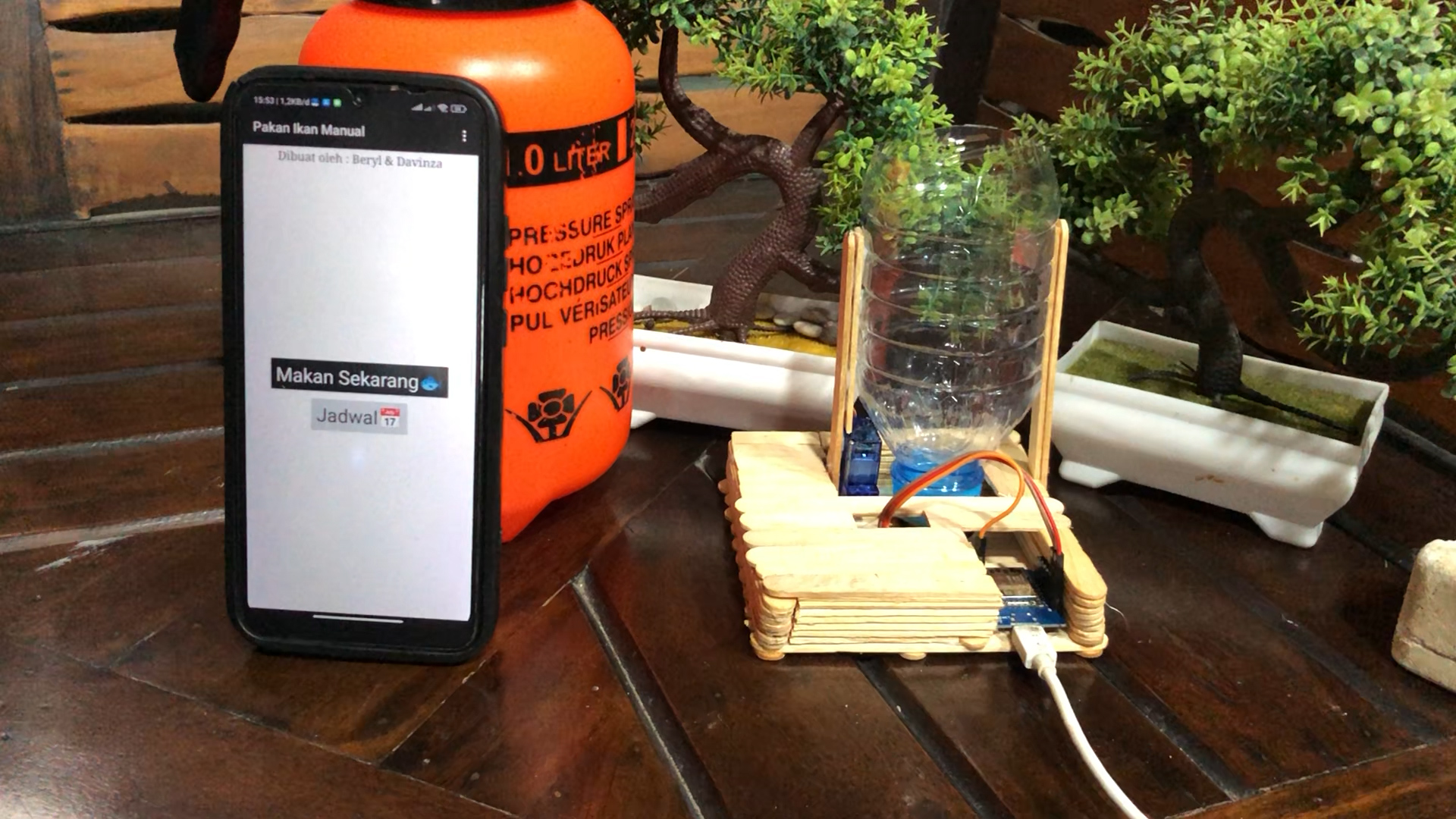
This Automatic Fish Feeder is a device designed to provide fish food on a schedule or manually using a microcontroller-based electronic system. This device aims to make it easier for fish owners to maintain a regular feeding schedule without having to constantly feed them directly.
Detailed Specifications
| Component | Specification | Role |
| Microcontroller | Wemos D1 Mini | System controller |
| Servo Motor | SG90 | Food dispenser mechanism |
| Jumper Wires | Male-Male | Electrical connection |
| Micro USB | Micro USB Cable | Power supply and programming interface |
| MIT App | Mobile App | User interface |
Detailed Explanation
Wemos D1 Mini
The Wemos D1 Mini is an ESP8266-based microcontroller with an integrated WiFi module. This component serves as the system's control center.
•Ways of Working
The Wemos D1 Mini is the control center or brain of the automated fish feeding system. This component is based on the ESP8266 and is equipped with a WiFi module so it can connect to the internet or a hotspot. Wemos receives commands from a smartphone application and then processes them according to a previously uploaded program. After that, Wemos sends a PWM (Pulse Width Modulation) control signal to the servo motor to drive the opening and closing mechanism of the feed container. If the system uses an automatic schedule, Wemos also functions as a timer that will activate the servo at a predetermined time.
SG90 SG-90
The SG90 servo is a small motor that can rotate at a certain angle 0°–90° based on the PWM signal received from the microcontroller.
•Ways of Working
The SG90 servo motor drives the feed ejection mechanism. This servo operates based on a PWM signal received from the Wemos D1 Mini. The magnitude of the transmitted signal determines the servo's rotation angle, for example, from 0 degrees to 90 degrees. When the servo rotates, the arm or lever attached to it opens a valve or gap in the feed container, allowing a specific amount of feed to be released. Once the process is complete, the servo returns to its original position to close the feed container.
Jumper Cables
Jumper cable is used as a connection medium between Wemos and servo.
•Ways of Working
Jumper cables act as connectors between system components. These cables transmit electrical voltage (VCC), ground (GND), and control signals from the Wemos D1 Mini to the servo motors. Without jumper cables, there would be no path for power or signals, preventing the system from functioning properly.
Mit App
The MIT App serves as a user interface to control the system.
•Ways of Working
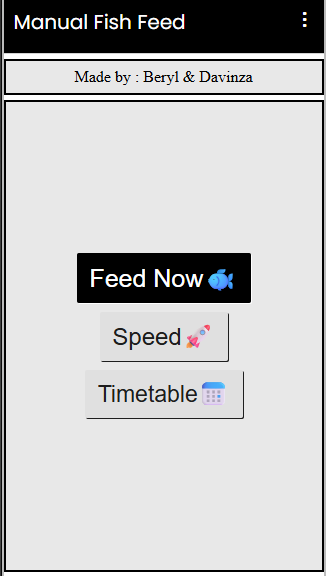
MIT App Inventor creates an app used to control the system via smartphone. Through this app, users can press buttons such as Feed Now or set a feeding schedule. Commands given to the app are sent via WiFi to the Wemos D1 Mini. The app doesn't directly move the servos, but rather sends commands, which are then processed by the Wemos to run the automated feeding system.
Feature
Automatic feeding schedule
Control through the application
Device monitoring via Wi-Fi
Usage
1. Plug the Micro USB cable into the microcontroller (Wemos D1 Mini).
2. Download the application that has been created.
3. Wait until the device's Wi-Fi network appears on your device.
4. Connect to the Wi-Fi network using the name and password configured on the microcontroller.
5. Open the application you downloaded.
6. Then you can choose “Feed Now” or set a feeding schedule.
Troubleshooting
1. Issue : The Micro USB cable low power.
Solution: Use or purchase a Fast Charging Micro USB cable.